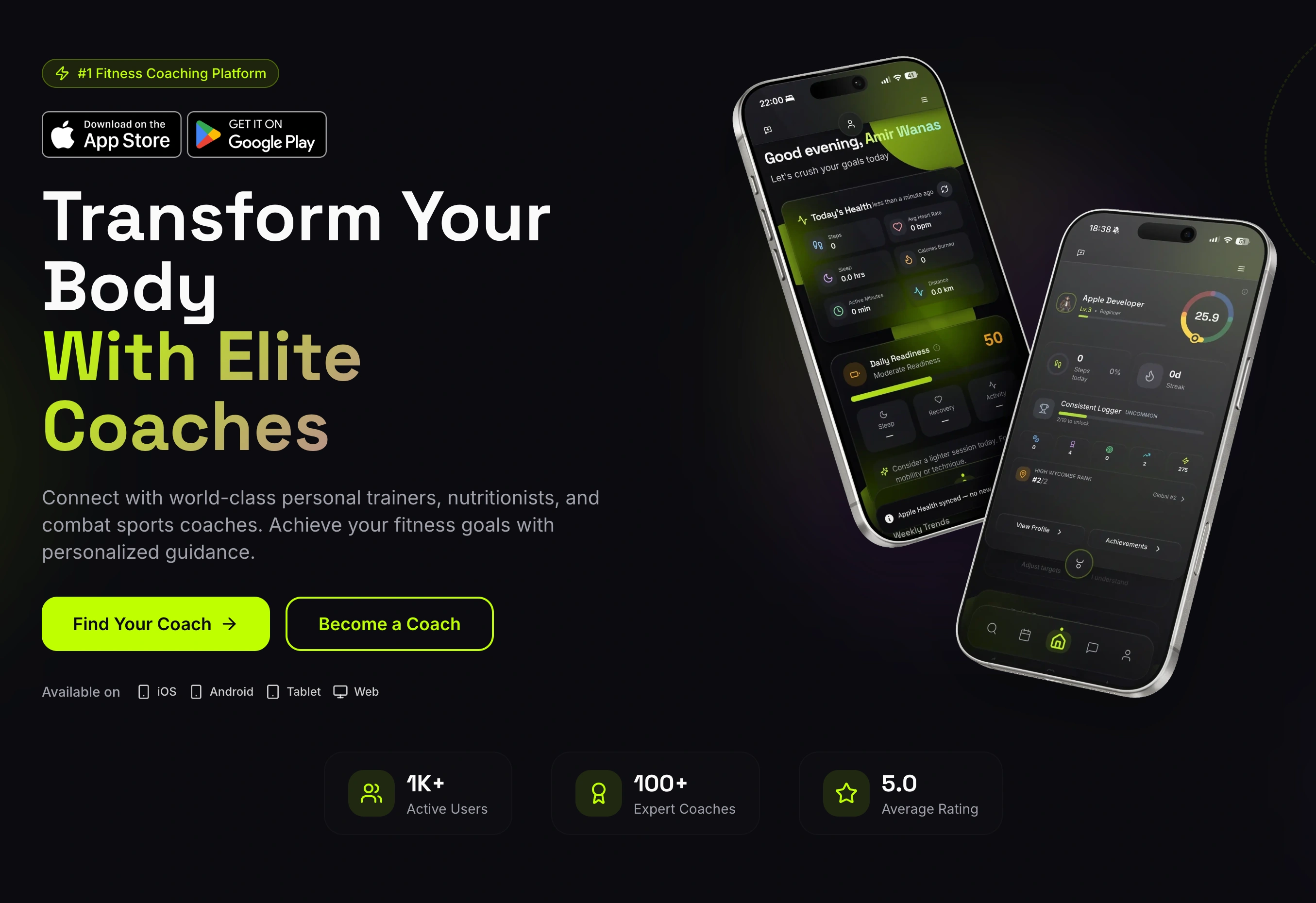
Building FitConnect
A Platform Engineered to Transform Fitness Coaching

It's the numbers that matter!
180+
Days in Development
850000+
Lines of Code
200+
Features Delivered
100+
Database Policies

THE CHALLENGE
The fitness coaching industry was broken across a dozen disconnected tools. Coaches juggled separate apps for scheduling, payments, programming, nutrition and client communication. Clients had no single destination to discover a coach, book a session, follow a plan and track their progress. The experience was fragmented on both sides — and it was costing coaches clients.
Beyond the tooling problem, there was a trust problem. Clients had no reliable way to verify a coach's credentials, compare pricing transparently or read honest reviews before committing. Coaches had no way to showcase their results, automate their admin or scale beyond a handful of clients without drowning in spreadsheets and WhatsApp threads.
We were asked to build a platform that would unify the entire coach-client relationship — from first discovery to long-term transformation — while giving platform administrators full oversight, monetisation control and the tools to grow a marketplace. The scope was substantial: three distinct user roles, over 200 features, AI-powered tooling, wearable integration, payment processing and a gamification layer to drive retention.

OUR SOLUTION
We built FitConnect — a comprehensive fitness coaching platform that brings clients, coaches and administrators together in one ecosystem.
For Clients: A searchable marketplace to discover verified coaches across 30+ disciplines — from personal training and boxing to tennis, swimming, MMA and yoga. Clients book sessions 24/7, receive personalised workout and nutrition plans, sync health data from Apple Health, Google Fit, Fitbit or Garmin, track progress through visual dashboards, and stay motivated through badges, leaderboards and challenges. AI-powered tools calculate calorie and macro targets, suggest meal plans that respect allergies and dietary preferences, and generate shopping lists integrated with Tesco, Sainsbury's and Asda for one-click grocery ordering.
For Coaches: A command centre that consolidates everything. Client management with engagement scoring and churn risk alerts. A drag-and-drop workout builder with a full exercise library and video support. AI-powered programme and nutrition plan generation — always under coach review before delivery. Automated check-ins, progress reports and re-engagement sequences. Stripe-powered payments with support for single sessions, packages, subscriptions and digital product sales. Marketing tools including email campaigns, social media content and a Boost system for premium marketplace placement.
For Administrators: Full platform control. Coach verification workflows with document review. Subscription tier management and granted subscriptions. Revenue dashboards, content moderation, configurable automation rules and secure impersonation sessions with full audit logging. Multi-location gym support with role-based access for owners, area managers, managers and staff.

THE PROCESS
Discovery & Architecture We mapped three complete user journeys and identified over 200 discrete features. We prioritised ruthlessly, building iteratively rather than attempting everything at once. The database schema came first — 50+ tables designed with row-level security policies on every access path, ensuring data protection was foundational, not bolted on.
Stack & Standards We built on React with TypeScript in strict mode, Vite for fast development, and Tailwind CSS with a semantic design token system for consistent theming across light and dark modes. The backend runs on Lovable Cloud, providing authentication, PostgreSQL, edge functions, file storage and real-time capabilities. Every component follows a strict four-layer architecture: Page → Feature → UI → Layout. No component crosses its boundary.
AI Integration We integrated AI as an accelerator, not a replacement. Five AI-powered features — programme generation, nutrition planning, calorie calculation, case study generation and client progress summaries — all funnel through coach approval before reaching the client. The coach stays in control. The AI handles the heavy lifting.
Engagement & Retention We built a comprehensive gamification layer: badges earned for consistency, leaderboards ranked by location, time-bound challenges with XP and avatar rewards, daily habit tracking with streaks, and visual progress charts. Push notifications and real-time messaging keep users connected across web and mobile.
Payments & Monetisation Stripe powers the entire financial layer — session payments, recurring subscriptions, package deals and digital product sales. Revenue flows through three streams: tiered coach subscriptions, Boost advertising for marketplace visibility, and transaction fees on bookings.
Iteration & Refinement Each feature was built, tested and refined before moving to the next. We maintained strict TypeScript throughout — no any, no @ts-ignore, no shortcuts. Multi-language support was implemented via i18next with structured translation files. PWA capability was added for a native-like mobile experience.

THE RESULTS
What We Delivered
Components built 300+
Database tables 50+
Edge functions 15+
Supported disciplines 30+
Coach specialisations 90+
Wearable platforms supported 4
Supermarket integrations 3
AI-powered features 5
A full-stack fitness coaching platform with three distinct user roles, responsive from 320px mobile to 1440px+ desktop, with full dark mode support, multi-language capability and PWA readiness. Every data access path is secured with row-level security. Every AI output requires human approval. Every payment flow is production-grade.
The platform doesn't just connect coaches and clients — it gives coaches the tools to scale their business and gives clients the structure to achieve their goals.

WHAT WE LEARNED
We assumed the hardest part of building the platform would be the scale. Three user roles, hundreds of features, integrations with wearables, payments, AI tools and a marketplace layer. On paper it looked like a massive technical challenge. But the real discovery was that complexity wasn’t the problem — visibility of that complexity was. When too much of the system surfaced in the interface, the experience quickly became overwhelming. Clients didn’t want to understand the platform. They just wanted to find a coach, book a session and see their progress. Coaches didn’t want more dashboards. They wanted fewer spreadsheets and less admin.
That realisation changed how we approached the product. Instead of thinking about what features to build next, we focused on the journeys people were trying to complete. Discover a coach. Deliver a programme. Track progress. Retain a client. Every decision started from those outcomes. AI followed the same thinking. Rather than positioning it as the centrepiece, we used it quietly behind the scenes to remove repetitive work while keeping coaches in control of the final output.
For businesses building platforms or complex products, the biggest risk is trying to show everything you’ve built. Users don’t need to see the system — they just need the result. Map the full journey someone takes through your product and remove anything that slows that journey down. The more powerful your system becomes, the more important it is that the experience feels simple.


We use cookies to enhance your experience. By continuing to visit this site you agree to our use of cookies. Read our cookie policy